Building the AI Assembly Line: How Scrydon's Cognitive Enterprise turns McKinsey's vision into Reality
How Scrydon's Cognitive Enterprise implements McKinsey's AI assembly line for sovereign, regulated organisations.

In their recent article "The AI Assembly Line: Strategic imperatives for CEOs", McKinsey paints a compelling picture of what's required to move beyond AI pilots and achieve enterprise-scale impact. They argue that the real breakthrough comes not from more tools, but from redesigning end-to-end workflows around Agentic AI, creating a modern "assembly line" for cognitive work where specialised agents handle repetitive tasks, an orchestration layer acts as the conveyor belt, and standardised data foundations enable seamless coordination.
This resonates deeply with what we observe daily: Most organisations have great people, broken processes, and data they can't use. Scrydon deliberately fixes two out of three.
We've built the Cognitive Enterprise, a unified Sovereign AI & Data platform that provides exactly the architectural foundation McKinsey calls for, purpose-built for European and regulated environments where control, sovereignty, and governance are non-negotiable.
The AI Assembly Line Meets the Cognitive Enterprise
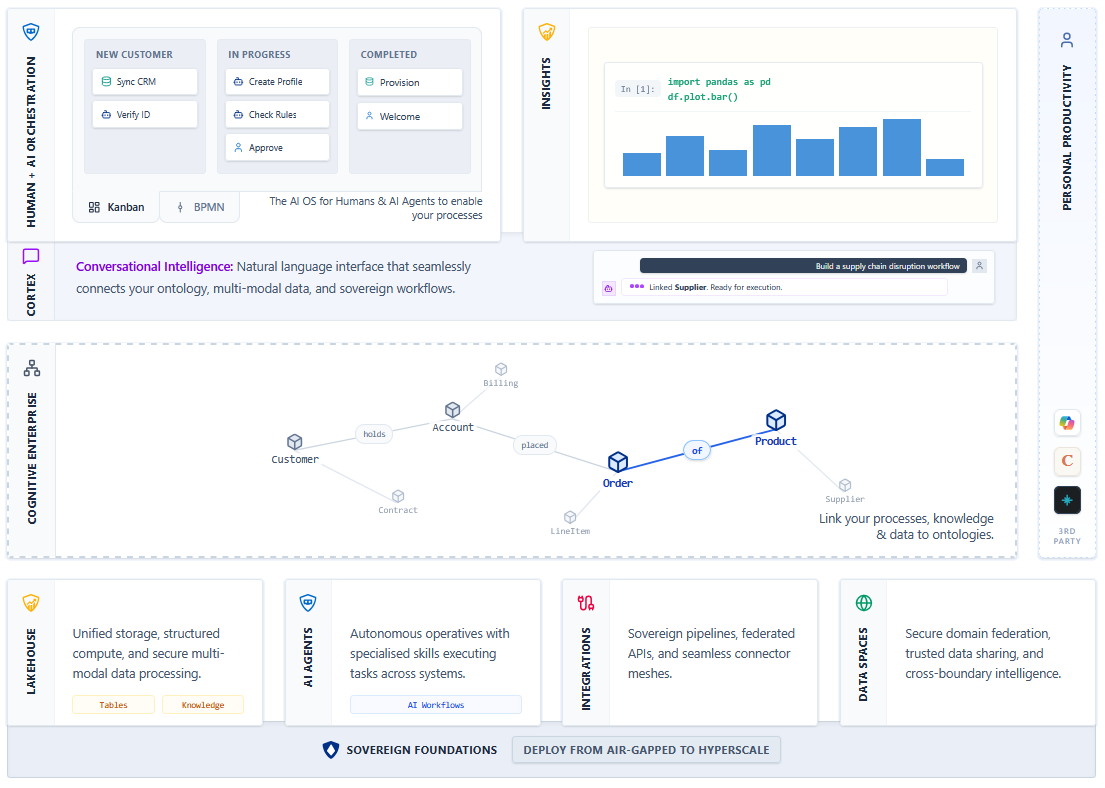
McKinsey's diagram is precise: four layers sit between raw data and a completed cognitive task. Specifically in the "Technology: Creating a conveyor belt for intelligence" section, McKinsey lays out how these layers fit together. From bottom to top, a toolbox of data connections, an agentic workforce, an orchestration layer, and the enterprise context that gives every agent the information it needs to learn and adapt. Scrydon maps onto that structure layer for layer.
① Enterprise context → The Ontology
McKinsey's first node carries a simple but powerful promise: "Information on the enterprise context is readily available, allowing agents to learn and adapt." That is exactly what Scrydon's Ontology delivers, a living semantic model built from your Data, Processes, Knowledge, and Expertise. Every metric, decision, and action is anchored to real business entities (accounts, contracts, orders, processes). Agents don't reason on noise; they reason on your actual business reality. No reconciliation. No silos.
② Agentic orchestration layer → Human + AI Orchestrator (the AI OS)
McKinsey defines this layer as the one that "routes the right agents to tasks and provides the right context for the task", explicitly noting that a sales agent must coordinate with a production agent. The Scrydon AI OS is that orchestrator. It makes every process visible (whether it lives in an ERP/CRM or in someone's head), structures it, and intelligently routes each step to the right executor: an AI Agent, an existing system, or a human. It schedules, governs, captures outcomes, and continuously enriches the Ontology, creating a self-improving record of how your organisation actually operates.
③ Agentic workforce → AI Agents
McKinsey's workforce is a pool of specialised agents, each with a distinct skill set, coordinated by the orchestration layer above and fed by the toolbox below. Scrydon's AI Agents work exactly this way: purpose-built for a domain (finance, procurement, logistics, compliance), they execute tasks across systems while the orchestrator handles the cross-agent coordination McKinsey's diagram shows as bidirectional arrows between the workforce and the orchestration layer.
Toolbox and data connections → Lakehouse + Integrations + Data Spaces
McKinsey's toolbox feeds agents with four source types: legacy systems (e.g., ERP), purpose-built solutions (e.g., forecasting engines), data repositories (e.g., data lakes), and applications (e.g., email, web search). Scrydon's Lakehouse and integrations cover all four, unified storage, compute, vector search, and embeddings alongside sovereign pipelines that reach any existing system. Data Spaces extend this with secure federated sharing for cross-organisation collaboration.
Insights Layer + Cortex → The human in the loop
What McKinsey's diagram leaves implicit, the human who reads the output and acts on it, Scrydon makes explicit. Always-current dashboards link every number back to its source (account, process, contract). Cortex, the natural language interface, lets anyone query the full stack, trigger workflows, or interrogate the knowledge graph without technical barriers, keeping people firmly in control at every level of the assembly line.
Delivering McKinsey's Six Strategic Themes
Scrydon doesn't just support the transformation, it operationalises it — mapping McKinsey's six themes onto four platform capabilities:
- Strategy & Operating Model: Start with your processes. Make them executable and observable. Redesign roles around human-AI collaboration rather than replacing people.
- Technology & Data: A single coherent stack (not loosely coupled tools) that deploys from fully air-gapped on-prem to hyperscale cloud while maintaining full ownership and governance.
- Talent & Adoption: Your great people remain the strongest asset. The platform augments them with superpowers (Cortex for instant access, Insights that anticipate needs, agents that handle the grind) while keeping humans firmly in control.
- Scaling: Because everything shares the same ontology and orchestration, capabilities are inherently reusable and composable.
Scrydon is architecturally distinct from the usual suspects:
- Unlike Palantir: Sovereign, transparent, and built for European requirements rather than US-anchored opacity.
- Unlike Databricks: Goes far beyond the lakehouse into full semantic reasoning, process orchestration, and agentic execution.
- Unlike personal tools (e.g., Claude): enterprise AI deeply embedded in your enterprise data layer with complete control over where and how it runs.
Why This Matters Now
"The AI assembly line will not simply enhance decision-making; it will industrialize the process, using customized agents specifically designed for each company. When the cost of judgment falls and its availability scales, personalization becomes standard, forecasting becomes continuous, and organizations can pivot in near real time. This shift requires more than technology, it demands a CEO-led redesign of workflows, roles, and governance to ensure that the speed of operations matches the speed of intelligence."
— McKinsey
As McKinsey notes, Chinese automakers collapsed vehicle development cycles to 24 months using AI-integrated workflows. Western leaders can achieve similar leaps in regulated sectors, if they have the right foundation.
Scrydon gives CEOs and their leadership teams the "chief architect" toolkit: a platform where you can rewire processes, deploy trustworthy agents, maintain full data sovereignty, and deliver contextual intelligence to both humans and AI without compromising compliance or control.
Most organisations have great people, broken processes, and data they can't use. We fix two out of three. Deliberately.
Ready to explore what the Cognitive Enterprise can do in your environment?
Let's build your AI assembly line, on your terms, under your governance, and with full strategic autonomy.