Self-Service Analytics
Your data team shouldn't be a queue. Plain-language questions, governed answers, numbers that agree across the whole organisation — delivered the moment they matter, making every decision-maker their own analyst.
The measure of an analytics platform is not the dashboards — it is how long the gap is between a question and a trustworthy answer, and how much of your data team's week goes into closing it by hand. This page is about collapsing that gap for the people asking, and giving the data team their week back.
Read this if you're tired of two dashboards disagreeing, or of a data team that has become a queue.
Scrydon Analytics is the self-service analytics layer that lets business users and analysts get answers without waiting on a data team. They ask questions in plain language, explore governed dashboards and reports, and receive the right information proactively — without asking. Because every metric is anchored to the ontology, the answers are consistent and trustworthy across the whole organisation.
In most organisations there is a bottleneck between people and their data: every question becomes a ticket, every report a wait. Scrydon Analytics removes that bottleneck. It puts trustworthy, self-service analytics directly in the hands of the people who make decisions — in natural language, in dashboards and reports they can explore themselves, and in proactive alerts pushed to them the moment something matters. Because everything is anchored to the ontology, what they see is governed, consistent, and dependable, whether they are technical or not.
Ask in Plain Language
Pose questions the way you would to a colleague and get answers grounded in your business — no SQL, no waiting on a data team.
Dashboards & Reports
Explore self-service dashboards and reports, slice the numbers yourself, and share or export the results in a click.
The Right Information, Without Asking
Insight is delivered proactively — alerts and updates pushed to you the moment something changes, before you even think to ask.
Analytics in the Scrydon platform
One integrated, sovereign architecture. Here is where Analytics sits — highlighted against the full stack it works with.
The AI OS for Humans & AI Agents
Ontology & Semantic Layer, one connected model for your data, knowledge & processes
Combining the best of data lakes, data warehouses and search
Governed access to every model, and the agents & workflows that execute across your systems
Integrate across A2A, MCP, legacy systems and data sources
Secure domain federation, trusted data sharing, and cross-boundary intelligence
Sovereign Foundations
Analytics in depth
Analytics
Data sitting in warehouses and dashboards that nobody reads is data they can't use. The Analytics layer changes that — giving the right people the right information without them having to ask for it. Every metric is anchored to the Cognitive Enterprise ontology, so a revenue figure doesn't arrive in isolation. Data in context — not just in dashboards.
Decision-makers get a live view of the enterprise — financial performance, operational health, procurement status — without waiting for a data team to prepare a report.
- Interactive notebooks: Python and SQL environments with full access to your lakehouse data — no data movement required.
- Visual dashboards: Pre-built, always-current reporting updated automatically as the business moves — no manual refresh, no stale numbers.
- Agent-native analytics: AI agents can query, summarise, and act on insights autonomously — closing the loop between analysis and action.
Cognitive Enterprise
Ontology & Semantic Layer, one connected model for your data, knowledge & processes
Most organisations have data they can't use — not because it doesn't exist, but because nothing connects it. The Cognitive Enterprise layer is the defining intelligence of the AI OS: a living, queryable semantic model of your organisation's entities, processes, and rules. It is the single source of truth that allows every agent, analyst, and workflow to reason about your business with a consistent understanding.
Without it, AI agents reason on noise. With it, they reason on the business.
- Entity graph: Model customers, accounts, orders, products, and any domain concept — then connect them with typed, traversable relationships.
- Process integration: Link real-world workflows to ontology entities so agents understand how data flows through your business.
- Continuous enrichment: Agents automatically enrich ontology nodes with fresh data from the lakehouse, keeping the model current without manual effort.
The Lakehouse is the high-performance data foundation underpinning the Cognitive Enterprise. It is built on StarRocks — a blazing-fast, vectorised MPP query engine delivering sub-second analytics, real-time updates, and high concurrency — and queries open Apache Iceberg tables directly, merging the flexibility of a data lake with the speed of a warehouse under a single, sovereign roof.
- Open Iceberg tables: Query Apache Iceberg and other open table formats directly — your data stays yours, with no proprietary lock-in and no data movement.
- Lightning OLAP: StarRocks' vectorised engine, cost-based optimiser, and materialised views power real-time SQL — from dashboards to agent reasoning — without data duplication.
- Integrated Vector Search: Store and query embeddings alongside traditional data, making the Lakehouse instantly ready for AI workloads.
Reading this for a decision later?
Get the next change to European AI sovereignty, and what we learned building for it, in your inbox. A few times a year.
Answers for the people who make decisions
Analytics is built for end users, not just data engineers. It gives business users and analysts everything they need to answer their own questions — from natural-language queries to self-service dashboards to proactive alerts — all on a single, governed foundation so the numbers always reconcile.
It opens on the work rather than on an empty canvas: what you touched last, what the workspace actually holds, and the few things people start with — a notebook, a query, a table, a new source. The ontology and the graph are one click away, because the point of the workspace is that everything in it means the same thing.
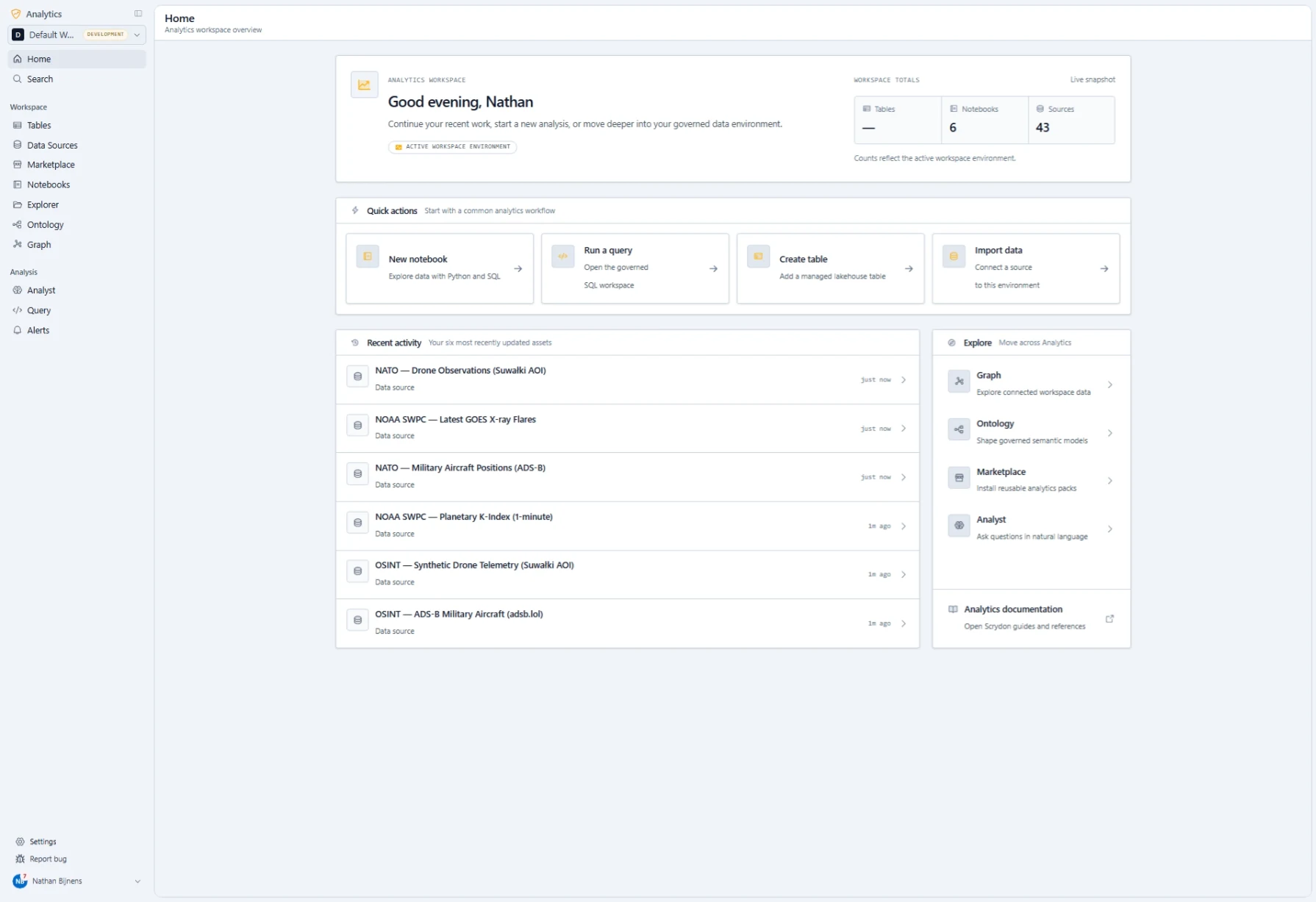
The workspace home: what the environment holds, what changed recently, and the four ways most work starts — with the ontology and the graph a click away.
A dashboard here is a layout, not a second artefact. The same notebook that proved something can be arranged on a grid — controls, tables and charts placed where a reader expects them — and handed to the people who need the picture rather than the code. There is no export step and no separate reporting tool to keep in sync: it is the same governed query behind the same numbers, presented for the reader instead of the author.
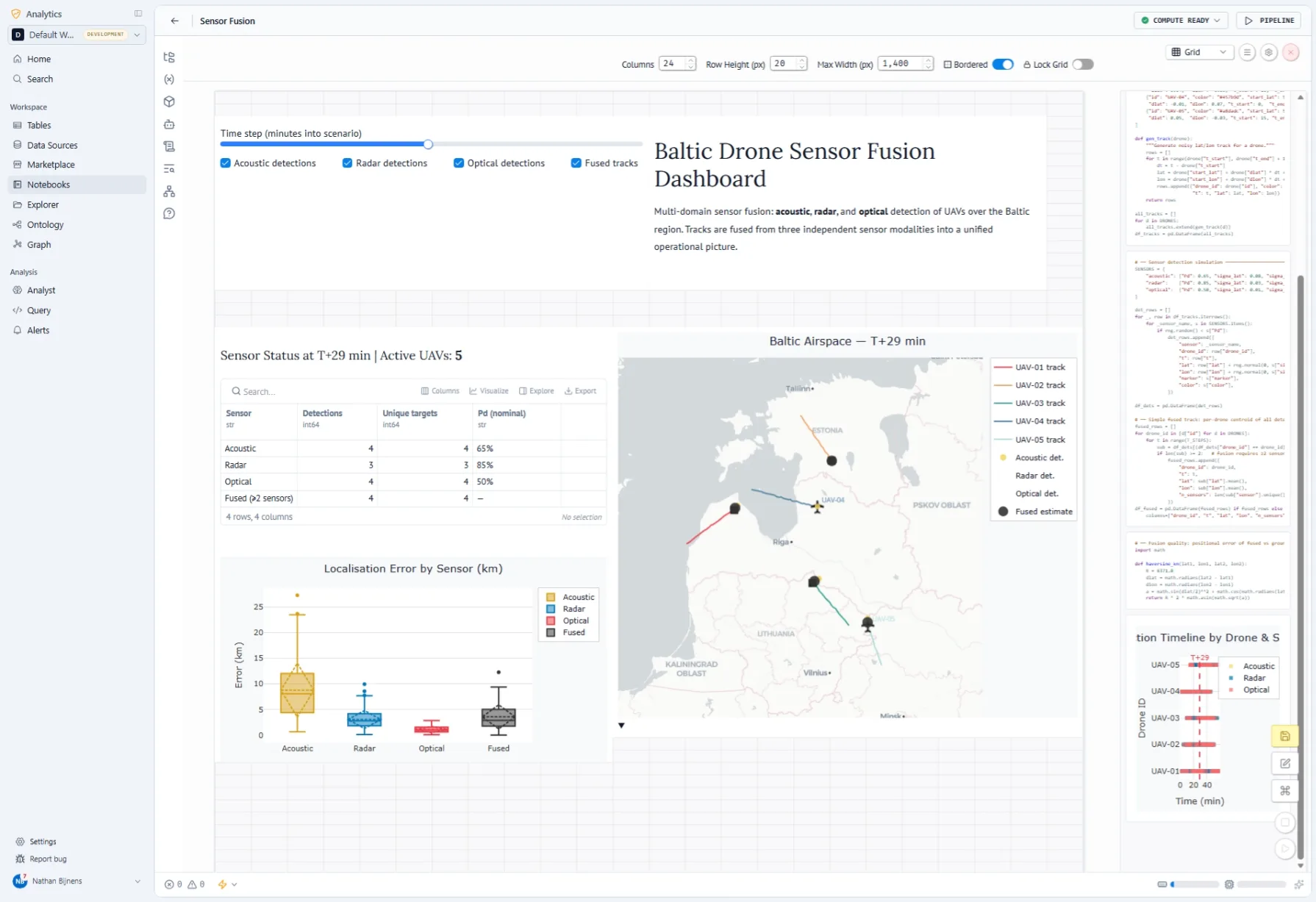
The same notebook, arranged as a dashboard: cells become panels on a grid, the controls stay live, and the reader gets an explorable view rather than a screenshot of one.
Ask in natural language — Type a question in plain English and get a clear, sourced answer drawn from your business data.
Self-service dashboards & reports — Build, explore, and drill into dashboards and reports yourself, without raising a ticket.
Proactive, pushed insight — Receive the right information automatically — alerts and updates delivered the moment they matter, without asking.
Consistent, governed metrics — Every figure is anchored to the ontology and defined once, so reports reconcile and access stays controlled.
Export & share — Share findings with colleagues or export them to the tools you already use, with lineage intact.
Remove the bottleneck between people and data
When every question has to queue behind a data team, decisions slow down and trust erodes. Analytics closes that gap: it hands self-service analytics to the people who need them while keeping everything governed and consistent underneath. Because every answer traces back to the ontology, self-service no longer means conflicting numbers — it means faster, more confident decisions on a single source of truth.
Frequently asked questions
What is Scrydon Analytics?+
What can end users actually do with Analytics?+
Do I need to be technical to use Analytics?+
Where does the data come from?+
Can I ask questions in natural language?+
Explore the platform
Prefer to write? Email hello [at] scrydon.com and we will get back to you.
Partners