The AI OS for Humans & Agents
Beyond copilots, beyond pilots: one governed runtime that turns your business processes into systems that improve with every run — and scales AI from a handful of users to the whole organisation.
What is an AI OS?
Your organisation already knows how its work is meant to flow. The AI OS is what actually runs that work — deciding, at every step, whether a person, an existing system or an AI agent should do it, and handing them what they need to do it well. It is how AI stops being a set of assistants and becomes the way the organisation operates.
Read this if you're the executive sponsor deciding whether AI moves beyond pilots — or the architect who will have to run it afterwards.
An AI OS (AI Operating System) — also called an Agentic OS — is the runtime that brings the right context to the right agent, system, or person at the right time. It starts from your business processes, maps each step to whoever should execute it — an existing system, an AI agent, or a human — and turns every interaction into new information linked to your ontology, so each run of the process is better informed than the last.
Most automation fails because the actor — human or AI — doesn't have the context to act well. Scrydon's sovereign AI OS fixes this at the source. It begins with the business process, decides which steps are handled by existing systems, which by AI agents, and which by people, and delivers each one exactly the context it needs. If your teams have already run copilots and AI pilots and now need organisational AI — governed and running across the whole organisation rather than one user at a time — the AI OS is the runtime that takes those experiments from pilots to production. Every interaction becomes new information, linked back to the ontology — so the next time the process runs, the AI OS brings even better context to the right agent or human at the right time.
Process-First
Start from the business process, then decide which steps are done by existing systems, which by AI agents, and which by humans.
Right Context, Right Actor
Bring exactly the context each step needs — drawn from the ontology and live data — to whoever is executing it, the moment they need it.
Every Interaction Learns
Each action and outcome becomes new information linked to the ontology, so the next run of the process is better informed.
Enterprise AI to production: the checklist
About thirty questions to put to your own team, grouped under grounding, governance, orchestration and sovereignty. Tick what is true for you today and see a score per dimension. One page, yours to print.
AI OS in the Scrydon platform
One integrated, sovereign architecture. Here is where AI OS sits — highlighted against the full stack it works with.
The AI OS for Humans & AI Agents
Ontology & Semantic Layer, one connected model for your data, knowledge & processes
Combining the best of data lakes, data warehouses and search
Governed access to every model, and the agents & workflows that execute across your systems
Integrate across A2A, MCP, legacy systems and data sources
Secure domain federation, trusted data sharing, and cross-boundary intelligence
Sovereign Foundations
AI OS in depth
Human + AI Orchestration
The AI OS for Humans & AI Agents
The Human + AI Orchestrator is the operational runtime at the heart of the AI OS — also called the Agentic OS — scheduling, routing, and governing every task across your enterprise, whether executed by an AI agent, an existing system, or a human.
Most organisations have broken processes: encoded in siloed systems or locked in people's heads. The AI OS makes them visible and executable. It captures intent, synthesises context, acts — then feeds every result back into the ontology so the next run is smarter. All of it inside your perimeter.
Your people are already great, and they likely already use powerful personal AI tools like Copilot, Claude, or ChatGPT. The problem is these tools operate in a vacuum. They don't understand your business, they lack access to your Cognitive Enterprise knowledge base, and feeding them corporate data introduces massive sovereignty risks.
Instead of trying to replace the tools your workforce already loves, we make them smarter and safer. The AI OS acts as a secure bridge that safely exposes your enterprise knowledge graph to these external assistants — without exposing your internal AI models or raw data infrastructure.
Private preview: linking personal AI tools directly to your Cognitive Enterprise — so assistants like Copilot, Claude, and ChatGPT can reason on your governed ontology — is available in private preview.
Cognitive Enterprise
Ontology & Semantic Layer, one connected model for your data, knowledge & processes
Most organisations have data they can't use — not because it doesn't exist, but because nothing connects it. The Cognitive Enterprise layer is the defining intelligence of the AI OS: a living, queryable semantic model of your organisation's entities, processes, and rules. It is the single source of truth that allows every agent, analyst, and workflow to reason about your business with a consistent understanding.
Without it, AI agents reason on noise. With it, they reason on the business.
- Entity graph: Model customers, accounts, orders, products, and any domain concept — then connect them with typed, traversable relationships.
- Process integration: Link real-world workflows to ontology entities so agents understand how data flows through your business.
- Continuous enrichment: Agents automatically enrich ontology nodes with fresh data from the lakehouse, keeping the model current without manual effort.
The AI Runtime is where AI actually executes: the AI Gateway that governs every model call, and the agentic AI workflows that turn those calls into work done across your systems. One is the way in, the other is what happens next — and both run under the same identity, policy and audit chain.
Two halves, one control plane:
- Gateway — one governed route to every model: Existing applications and coding agents point at a single endpoint instead of a vendor. Any model behind it, the vendor key never issued to a developer, and every call attributed to a person, capped and audited.
- Workflows — agentic AI that executes: Orchestrated workflows safely link frontier models, internal tools and enterprise memory, combining the reasoning of frontier AI with strict, deterministic steps so business-critical processes stay predictable.
- Autonomous execution within boundaries: Agents act autonomously inside defined limits, retrieving context from your data lakehouse and acting through approved tools — with a human in the loop wherever your policy says so.
Deployed securely inside your own infrastructure, the runtime draws on your cognitive enterprise to act decisively. Whichever half a call starts in, it resolves the same credential, meets the same policy and lands in the same audit trail — so adding governed agents later never means standing up a second control plane.
Reading this for a decision later?
Get the next change to European AI sovereignty, and what we learned building for it, in your inbox. A few times a year.
The right context, to the right AI agent, system, or human, at the right time
The AI OS doesn't start from models or data — it starts from your business process. It breaks the process into steps, determines who should perform each one, and assembles the precise context that step needs. Every interaction feeds back into the ontology, compounding the platform's understanding with each run.
A process is a real object here: stages, the tasks in each stage, who or what each task is assigned to — a person, an existing system, or an agent — and the gates that have to be satisfied before the next stage opens. Approvals and human-in-the-loop steps are ordinary steps, not exceptions bolted on afterwards.
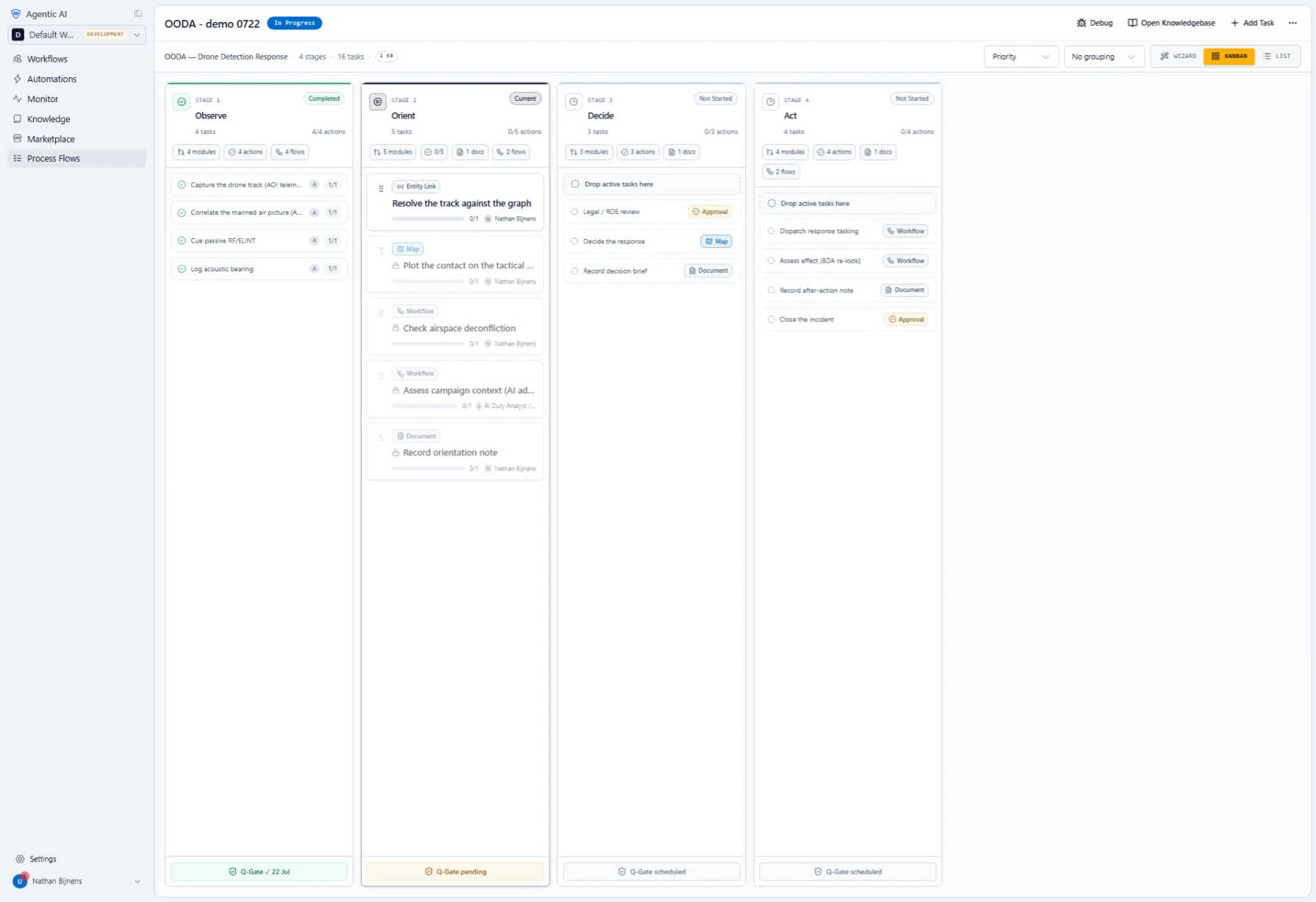
The whole process at a glance: stages, the tasks in each, what kind of step each task is, who owns it — and the gate that has to pass before the next stage opens.
The same process has a second face. Where the board is for whoever runs the operation, the guided view is for whoever is doing the work right now: one task at a time, what it is assigned to, what it produced, and — when an agent did it — the reasoning and the workflow run behind the result, available rather than hidden.
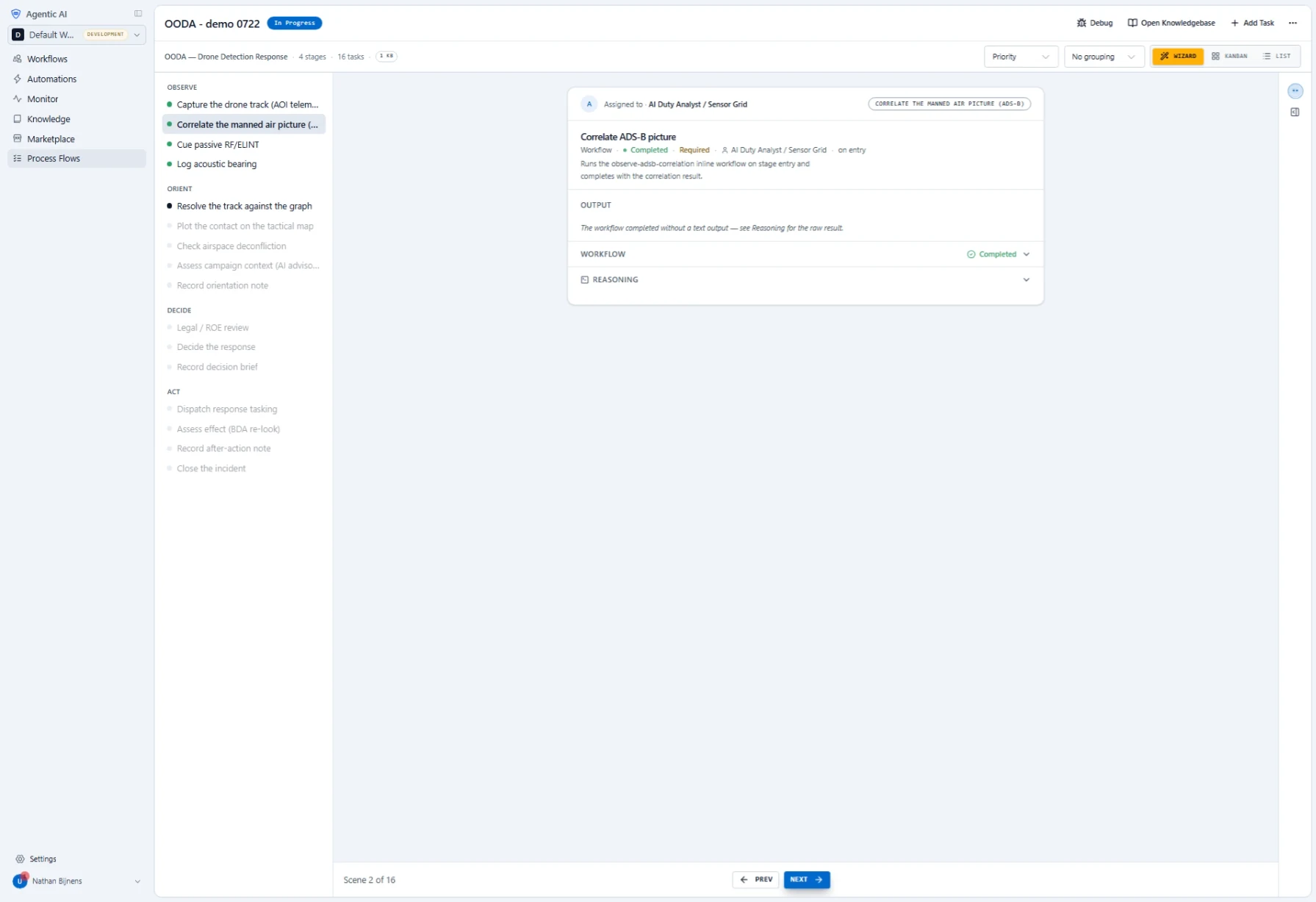
The same process, step by step: what this task is, who it is assigned to, what it produced, and the reasoning and workflow run behind an agent's result.
- 1
Start from the process
Model the business process end to end before deciding how each step is executed.
- 2
Assign each step
Route each step to the right actor: an existing system, an AI agent, or a human.
- 3
Deliver the context
Bring exactly the context that step needs, drawn from the ontology and live data.
- 4
Capture the interaction
Every action and outcome becomes new information, linked back to the ontology.
- 5
Improve every run
Next time the process runs, the AI OS brings even better context to the right actor at the right time.
Agents alone are not enough
Individual AI agents are powerful but ungoverned and context-blind. An AI OS gives them a shared runtime: a single place to schedule work, enforce policy, manage identity, and reason on a consistent model of the business — the layer that turns scattered pilots into enterprise AI. Without it, automation stays brittle and siloed; with it, processes become observable, governed, and continuously improving.
The next efficiency gains will not come from squeezing people harder. They come from whole processes running end to end, with humans and agents each doing the part they are best at — and from being able to see, stop and change that at any point. Automation you command, not automation that happens to you.
Frequently asked questions
What is an AI OS?+
Is an AI OS the same as an Agentic OS?+
How is an AI OS different from a single AI agent or chatbot?+
How does an AI OS work?+
Is an AI OS sovereign and secure?+
What is organisational AI?+
How is organisational AI different from personal AI like Microsoft Copilot or Claude Cowork?+
We've already run AI pilots and copilots — what's the next step?+
How does an AI OS support an AI Centre of Excellence (CoE)?+
What can you build on an AI OS?+
Prefer to write? Email hello [at] scrydon.com and we will get back to you.
Partners