Scrydon at VivaTech: Reflections on Sovereignty and the Cognitive Enterprise
Reflections from VivaTech 2026 in Paris, days after a US 'killswitch' cut Europe off from frontier AI models. Why going sovereign starts not with buying GPUs but with seeing your own data clearly — and how the Cognitive Enterprise makes that choice executable.


This June, Scrydon was in Paris for VivaTech — now in its tenth edition and, with more than 200,000 visitors, one of the largest technology events on the continent. We travelled with Flanders Investment & Trade as one of ten Flemish start-ups under the Belgian flag, alongside the Walloon and Brussels export agencies.
We arrived expecting the usual headliners — cloud, AI, robotics. Instead, one theme overshadowed everything: European digital sovereignty. And it wasn't abstract. Days before the show, a single US directive had shown how quickly access to frontier AI can vanish. The instinct across the floor was to "go local" — and it's the right instinct. But the first move isn't buying hardware. It's seeing your own data clearly enough to make a deliberate choice.
The "killswitch" that changed the conversation
Late on Friday 12 June, the White House ordered Anthropic to immediately cut off its most advanced models — Fable 5 and Mythos 5 — for everyone outside the United States, and for non-Americans inside it. The justification was national security. There was no warning and no consultation.
The direct economic damage was probably modest: those models had only recently reached European users, and on a small scale. But as a wake-up call it more than counts. A capability an organisation depended on disappeared overnight, by political decision, with no recourse. The uncomfortable question now sitting on European boards is simple: what if the next directive targets a model or a cloud service we actually run on?
The reaction was swift and largely political. Emmanuel Macron used the G7 in Évian and VivaTech itself to cast himself as champion of a "digitally sovereign" Europe; Germany was made guest country to project a Franco-German technological axis; France's domestic intelligence service swapped Palantir for a homegrown platform. AI, in short, has quietly become strategic infrastructure — and the incident showed exactly how a kill switch on that infrastructure works in practice. When something becomes critical infrastructure, the question stops being "is it the best tool?" and becomes "who can switch it off, and on whose authority?"
Sovereignty moved from the keynote stage to the procurement desk
The incident set the tone for the week. Germany's federal minister for digital transformation, Karsten Wildberger, tied it straight back to the killswitch:
"This is no longer an access debate; rules can change overnight, and sovereignty means we can still act if things like that happen."
— Karsten Wildberger, German Federal Minister for Digital Transformation and Government Modernisation
French cloud providers OVHcloud and Scaleway were among the biggest exhibitors, leaning into European data infrastructure and staff that sit entirely outside the reach of US authorities.
And it wasn't only politicians. Yann LeCun — AMI Labs chairman and former chief AI scientist at Meta — told the main stage that the push for sovereignty is right, warning that our information diet will soon be mediated by AI assistants and that we need access to a wide diversity of them. Concentrating that layer in any single jurisdiction is the risk; diversity and control are the answer.
A year ago "sovereign AI" was a panel topic people nodded along to. At VivaTech 2026 it showed up somewhere more consequential — in buying criteria. That mirrors what we documented when the European Commission published its Cloud Sovereignty Framework and ran it against a EUR 180 million procurement. Sovereignty is now scored, weighted, and decisive.
Sovereignty has a price — and "European" is not a feature
The honest voices in this debate are the useful ones. Capgemini's operations lead estimates that choosing a European cloud can cost up to 40% more. Founders point out that many companies genuinely cannot extract themselves from the US ecosystems they're wired into — it's hard to find real alternatives to the tools an entire organisation runs on, and being European can't be the first selection criterion when quality and fit still have to hold. Investors, meanwhile, can be wary of a sovereign focus that looks like cutting yourself off from the American and Chinese markets.
None of this argues against sovereignty. It argues against treating it as a slogan — and that is exactly why a pragmatic approach to sovereignty is necessary. Resilience is a cost you take on deliberately, in exchange for control, and the only way to spend that budget well is to know exactly which capabilities and which data are worth protecting: not everything needs to be sovereign, but the things that do, genuinely do.
The infrastructure answer is a spectrum, not a switch
The choice isn't "US cloud or bust." It's a spectrum — from a routing layer that lets you switch providers freely, to running models inside your own cloud, to self-hosted serving, to a fully local stack on hardware you control that keeps working through an outage, an export-control order, or a vendor going dark. Each step trades more control for more effort.
And the trade-off has to be honest: going local swaps a token bill for hardware, maintenance, security, and the people to run it — and people rarely beat tokens on cost, nor is a box on your own network automatically safer than a well-configured cloud. The point isn't that everyone should run models locally; it's that the landscape has shifted enough that every serious organisation now needs a deliberate position rather than an assumed one.
It starts with data, not GPUs
But every option on that spectrum assumes the same thing: that you already know your own data. Which workloads genuinely need a frontier model and which don't. Which information is sensitive enough to justify keeping in-house. Which use cases actually warrant the cost and effort of running your own stack. Every "infrastructure" decision is, underneath, a data decision.
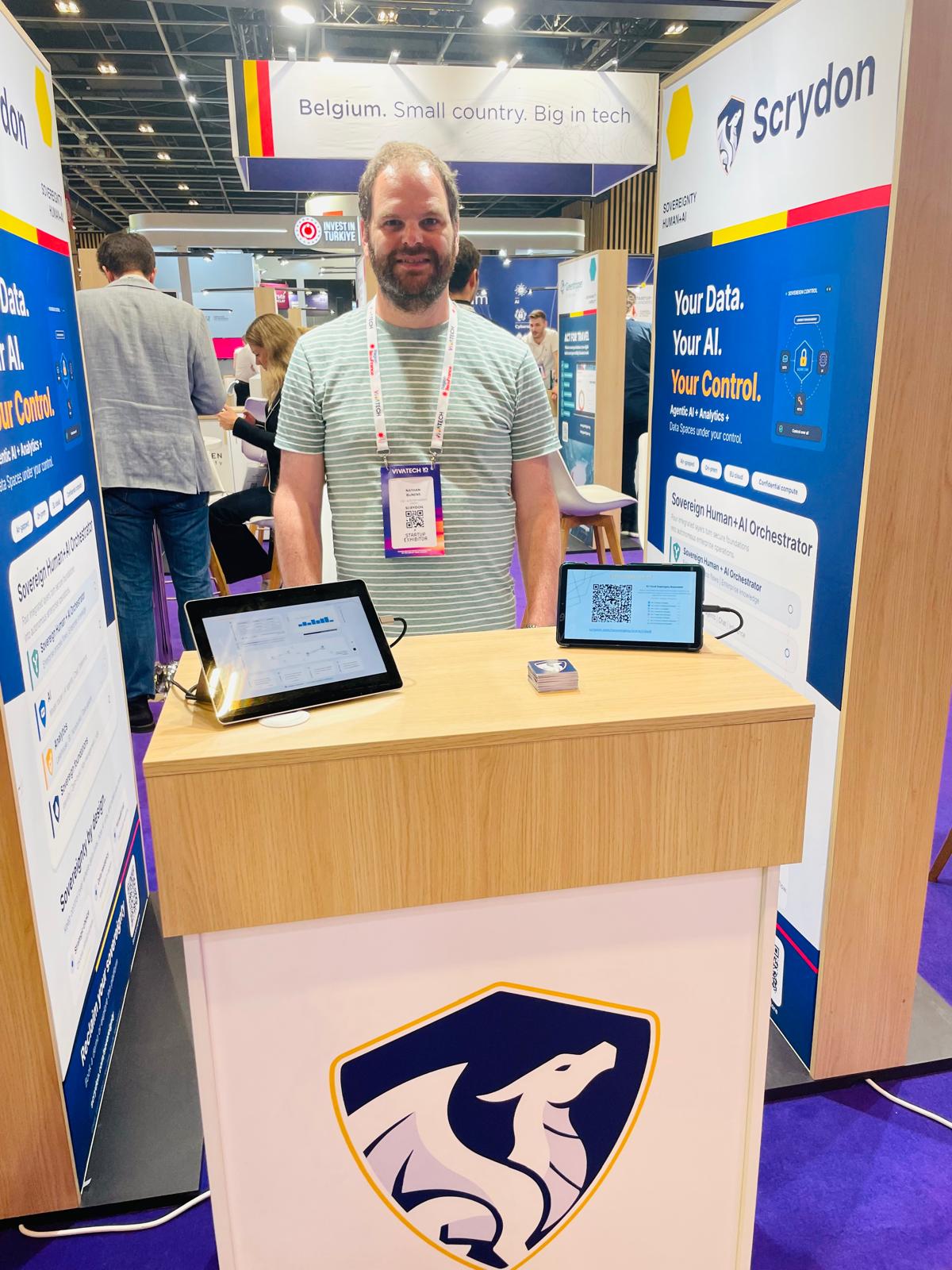
This is the part most organisations aren't ready for — and it's the heart of what we build. As we told Wim De Preter of De Tijd:
"Scrydon is building the Cognitive Enterprise — the brain of the organisation. That is sensitive information over which you really want to retain control. For us, sovereignty mostly means that as a company you must have the choice of where you place that critical information."
— Nathan Bijnens, CEO, Scrydon
You cannot exercise a choice you cannot see — and very few companies have a clear, current map of their own processes and data: what's sensitive, how it flows, what could move to a sovereign or local stack, and what genuinely cannot. That map is exactly what Scrydon builds: a living Ontology that turns your processes and data into a digital brain of the organisation, so sovereignty becomes a series of considered, reversible choices instead of improvisation under pressure. It's a conviction we heard echoed across the floor — Orange's CTO Bruno Zerbib made the same case for keeping the data and orchestration layers under your own control rather than renting them as a black-box service. That is exactly where the Cognitive Enterprise sits: owning the data layer and the orchestration layer, not renting them.
Governance turns a reaction into a position
The moment enterprise AI moves from drafting a paragraph to executing a workflow — approving an invoice, updating a record, triggering a downstream system — the tolerance for opacity collapses. Regulated organisations cannot deploy agents they cannot explain, which is why we build for Human+AI collaboration with strong guardrails: frontier reasoning combined with deterministic, fully auditable flows, with people firmly in the decision loop.
Holding a deliberate, informed position on vendor dependency — and re-examining it rather than assuming it — is, in our world, an AI governance deliverable. It means mapping your dependencies, classifying your data, writing the policy for where each class of workload may run, and defining the trigger conditions that would move a workload from one rung of the ladder to the next. For organisations already working toward ISO/IEC 42001 or aligning with the EU AI Act, the discipline isn't new; the 12 June directive simply made it urgent. The killswitch didn't create a new obligation so much as expose how few organisations were ready to act on one they already had.
Where Scrydon fits
This is the work the Cognitive Enterprise was built for: the digital brain that maps your processes and data, and the secure data spaces that let you share and deploy that knowledge without losing control of it. That foundation is what makes the sovereign choice executable instead of aspirational — it tells you which workloads can move down the ladder, which must stay where they are, and what the move would actually cost. Sovereignty, in the end, has to become product — and that is exactly what we are building.
Across financial services, government, defence, healthcare, and critical infrastructure, the pattern is the same: leaders want intelligence they can trust, deployed in an environment they control. Scrydon delivers:
- A Human+AI Orchestrator with strong guardrails for critical decisions
- Conversational Intelligence to query and act across the whole stack
- Insights on a unified, governed data foundation
- Secure, federated Data Spaces across organisations
- Sovereign Foundations — deploy anywhere along the spectrum, from hyperscale cloud to fully air-gapped on-prem
We're not arguing that everyone should pull their AI in-house. We're arguing that every organisation should be able to choose — and that most cannot yet, because they can't see their own data clearly enough to decide. The killswitch was a stress test, and Europe largely passed the awareness part. The harder test is whether companies build the data and governance foundation now, while it's a deliberate choice — rather than scrambling to assemble one the next time access disappears without warning.
Most organisations have great people, broken processes, and data they can't use. We fix two out of three. Deliberately.
If you spoke with us at VivaTech — or wish you had — and you're shaping a sovereign AI and data strategy, we'd love to continue the conversation.