



The Kinetic Layer: What Your Agents Are Allowed to Change
Most of the new ontologies and context layers are built for agents to read. The harder half is what an agent may change, as whom, and who signed off. Here is how Scrydon does it.

Everyone is jumping on ontologies, and with good reason. An ontology gives an agent context. It knows what a payment is and what "overdue" means in your company, so it stops guessing. Microsoft has Fabric IQ and Foundry IQ. Databricks has Genie. Snowflake has Horizon.
Nearly all of that is about reading. What is mostly missing is acting. Agents on those platforms can still do things, but through tools attached to the agent, outside the ontology.
Think of defence. Something shows up where it shouldn't, and somebody sends a drone to look. The picture and the order belong together, and the order has to be governed from end to end: who asked, who approved, what went out, what came back.
Palantir has a name for that half. Its documentation splits the Ontology into "semantic elements (objects, properties, links)" and "kinetic elements (actions, functions, dynamic security)", and says that "semantics must be paired with kinetics". The first half says what things are. The second says what you may do to them. Hence the kinetic layer.
We ran into the same thing building Scrydon. In July Nathan wrote that Palantir was right to make the ontology the brain and the model a component. This post is about the other half, and about one step we took further. In Scrydon three kinds of caller can ask to act on the ontology: a person, an agent working for a person, and a mission under a mandate somebody approved. The mission is still in build. Whoever asks, the request takes the same route.
This isn't new
Reinforcement learning has worked this way for decades. An agent is shown a state. It picks one of the actions the environment offers. The environment works out what happens and shows it the new state, with a reward. The agent has one way to change anything, and that is to pick an action. What the action does to the world is the environment's call.
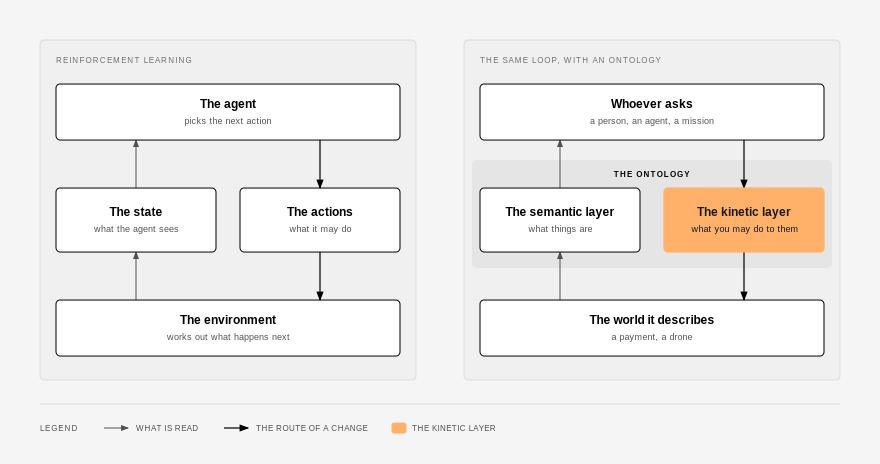
The same loop twice. On the left, the textbook version. On the right, the two halves of an ontology stand where the state and the actions were.
An ontology with a kinetic layer is the same loop. The semantic half is the state, what the world looks like right now. The kinetic half is the set of actions.
The textbook loop has no place for who may pick which action, or who signs for it. In a simulator nobody asks. In a bank or a control room it is most of the work, and it is the rest of this post.
Reading is the easy half
An agent that reads through governed definitions is a good analyst. It can tell you which payments look wrong. The trouble starts when you ask it to put one on hold.
In most stacks that is where the agent leaves the model. It calls a tool, and a tool is an API call with a description written for a language model. The layer that knew what a payment is has no say in whether this agent may hold this one.
So the things an auditor will ask about end up somewhere else. The agent often runs on a service account that can do far more than the person who asked. Somebody approved a summary on a screen, and nobody can show that what ran is what they saw.
You wouldn't accept that from a new colleague. They get a mandate, and there is a file.
How we do it
The ontology toolkit an agent gets in Scrydon has four tools. Three read: fetch an object, follow its links, search. The fourth runs an action. Through that toolkit there is no way to write a property directly.
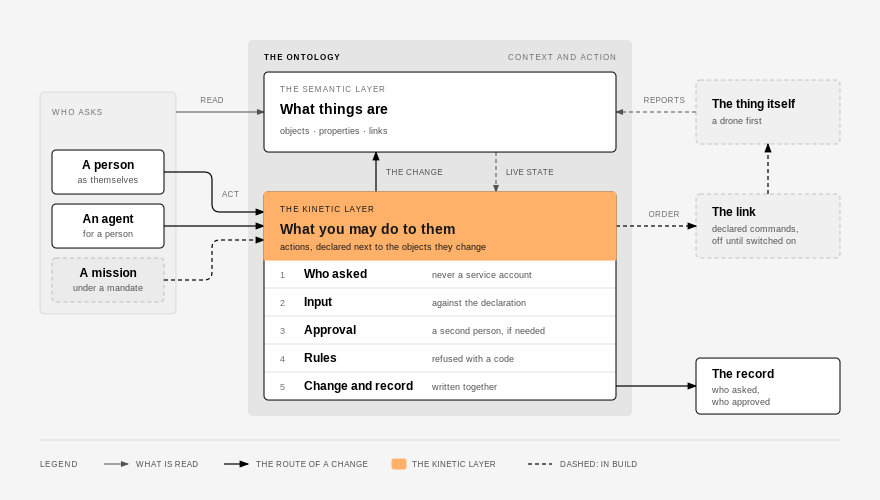
The ontology has two halves. One says what things are, the other what you may do to them. Whoever asks, a change takes the same route through the second half. The dashed parts are still in build.
An action is declared in the ontology, next to the objects it changes. The declaration says what input it takes, what it may write, which rules have to pass, and whether an administrator approves each request. A payment hold could look like this:
payment.hold
  input     paymentId, amountEur, reason
  writes    Payment.status = "held", Payment.holdReason
  rule      amount under 1,000,000 euros
  approval  an administrator, for every request
When an agent runs it, the same things happen in the same order.
The call carries the identity of the person the agent works for, or the grant a scheduled run was given. Never a service account. Without a verified identity the call fails. It doesn't fall back to something broader.
The input is checked against the declaration.
If the action needs approval, the request waits there. An administrator other than the requester decides, and what they approve is that exact request, down to the input and the version of the ontology it was made against. Change anything and the approval no longer fits. It works once, and it lapses after a day.
Then the request is checked against the declared rules. A refusal comes back with a code the workflow can branch on, and the refusal goes on the record too.
Last, the change and its record are written together. All of it or none of it.
The fields and the refusal codes are in the docs.
The agent can still be wrong. It can hold the wrong payment. But the change is one somebody declared, it was made as the person the agent works for, and the record says who asked and who approved.
Where the word stops being a metaphor
In a bank, "kinetic" is a figure of speech. In a control room an order moves a drone.
That is what our mission engineering work is about. It is still in build, so read this part as direction.
An order to a drone takes the same kind of route as the payment hold. The link to the drone declares the commands it accepts, and a real link is sent nothing until an administrator has switched it on. A playbook says what a mission may start without asking and what it must never do, and someone other than its authors approves it before it can run. Every order is then checked against that mandate before it goes out. A person can also take control of one drone directly, for a limited time, and the pilot's radio still overrides them.
Next we want those commands declared on the object type itself, so that closing a gate or stopping a pump is checked the same way as landing a drone. That part is design work today.
None of this replaces a command-and-control system you already run. Tasking an asset through that system is on the roadmap, and further out.
If you have a list of the actions you'd want declared, or the start of one, send it over. We'll go through it and tell you which ones are an action today and which should stay with a person. Talk to us.