The No-Code AI Agent Builder
Drag, drop, deploy — and stay governed. The visual canvas where analysts and business teams build real agent workflows that run under the same rules as everything engineering ships.
What are no-code AI agents?
Organisations usually face a bad choice: let business teams automate with whatever tools they find, and lose track of what exists — or route everything through engineering, and watch ideas die in the backlog. This page is about the third option, where building is easy and oversight is automatic.
Read this if you're a business or operations lead who wants to automate a process without joining an engineering backlog.
No-code AI agent workflows let business users and analysts build, connect, and deploy AI agents through a visual, drag-and-drop builder instead of writing orchestration code. Every workflow they compose still runs on the governed AI OS runtime, inheriting the same identity, scoped access, approvals, and audit trail as agents built by engineers.
Most agent backlogs are not blocked on model quality — they are blocked on engineering time. The person who understands a workflow best is usually the analyst or operations lead running it, not the developer waiting to be assigned to it. Scrydon's no-code builder lets that person drag together steps, connect enterprise tools and data sources, and compose approvals and agent reasoning into a working automation directly on the canvas. Nothing about the shortcut to build is a shortcut around governance: the workflow compiles to the same AI OS runtime as hand-coded agents, grounded in your ontology and contained inside your perimeter from the first draft.
Drag, Connect, Ship
Compose agent steps on a visual canvas and wire them to enterprise tools, data sources, and models as native building blocks — no orchestration code to write.
Built By The People Who Know The Process
Analysts and business teams turn their own process knowledge into a working agent workflow directly, instead of waiting on an engineering backlog.
Same Governance, Every Time
Identity, scoped permissions, approvals, and a full audit trail apply automatically to every workflow a business user builds — no separate, ungoverned path.
No-Code AI Agents in the Scrydon platform
One integrated, sovereign architecture. Here is where No-Code AI Agents sits — highlighted against the full stack it works with.
The AI OS for Humans & AI Agents
Ontology & Semantic Layer, one connected model for your data, knowledge & processes
Combining the best of data lakes, data warehouses and search
Governed access to every model, and the agents & workflows that execute across your systems
Integrate across A2A, MCP, legacy systems and data sources
Secure domain federation, trusted data sharing, and cross-boundary intelligence
Sovereign Foundations
No-Code AI Agents in depth
Human + AI Orchestration
The AI OS for Humans & AI Agents
The Human + AI Orchestrator is the operational runtime at the heart of the AI OS — also called the Agentic OS — scheduling, routing, and governing every task across your enterprise, whether executed by an AI agent, an existing system, or a human.
Most organisations have broken processes: encoded in siloed systems or locked in people's heads. The AI OS makes them visible and executable. It captures intent, synthesises context, acts — then feeds every result back into the ontology so the next run is smarter. All of it inside your perimeter.
The AI Runtime is where AI actually executes: the AI Gateway that governs every model call, and the agentic AI workflows that turn those calls into work done across your systems. One is the way in, the other is what happens next — and both run under the same identity, policy and audit chain.
Two halves, one control plane:
- Gateway — one governed route to every model: Existing applications and coding agents point at a single endpoint instead of a vendor. Any model behind it, the vendor key never issued to a developer, and every call attributed to a person, capped and audited.
- Workflows — agentic AI that executes: Orchestrated workflows safely link frontier models, internal tools and enterprise memory, combining the reasoning of frontier AI with strict, deterministic steps so business-critical processes stay predictable.
- Autonomous execution within boundaries: Agents act autonomously inside defined limits, retrieving context from your data lakehouse and acting through approved tools — with a human in the loop wherever your policy says so.
Deployed securely inside your own infrastructure, the runtime draws on your cognitive enterprise to act decisively. Whichever half a call starts in, it resolves the same credential, meets the same policy and lands in the same audit trail — so adding governed agents later never means standing up a second control plane.
Reading this for a decision later?
Get the next change to European AI sovereignty, and what we learned building for it, in your inbox. A few times a year.
Visual workflows for AI agents
Building an agent workflow starts on a canvas, not in a code editor. A business user drags in steps, wires them to enterprise tools and data sources already exposed as connectors, and inserts an agent reasoning step wherever judgment is needed rather than a fixed rule. Approval gates, branching logic, and autonomous steps sit side by side in the same flow, so a workflow can be as deterministic or as agentic as the process actually requires. Publishing a workflow doesn't hand it to a separate, lighter-weight runtime — it deploys straight onto the same AI OS that runs every other agent on the platform.
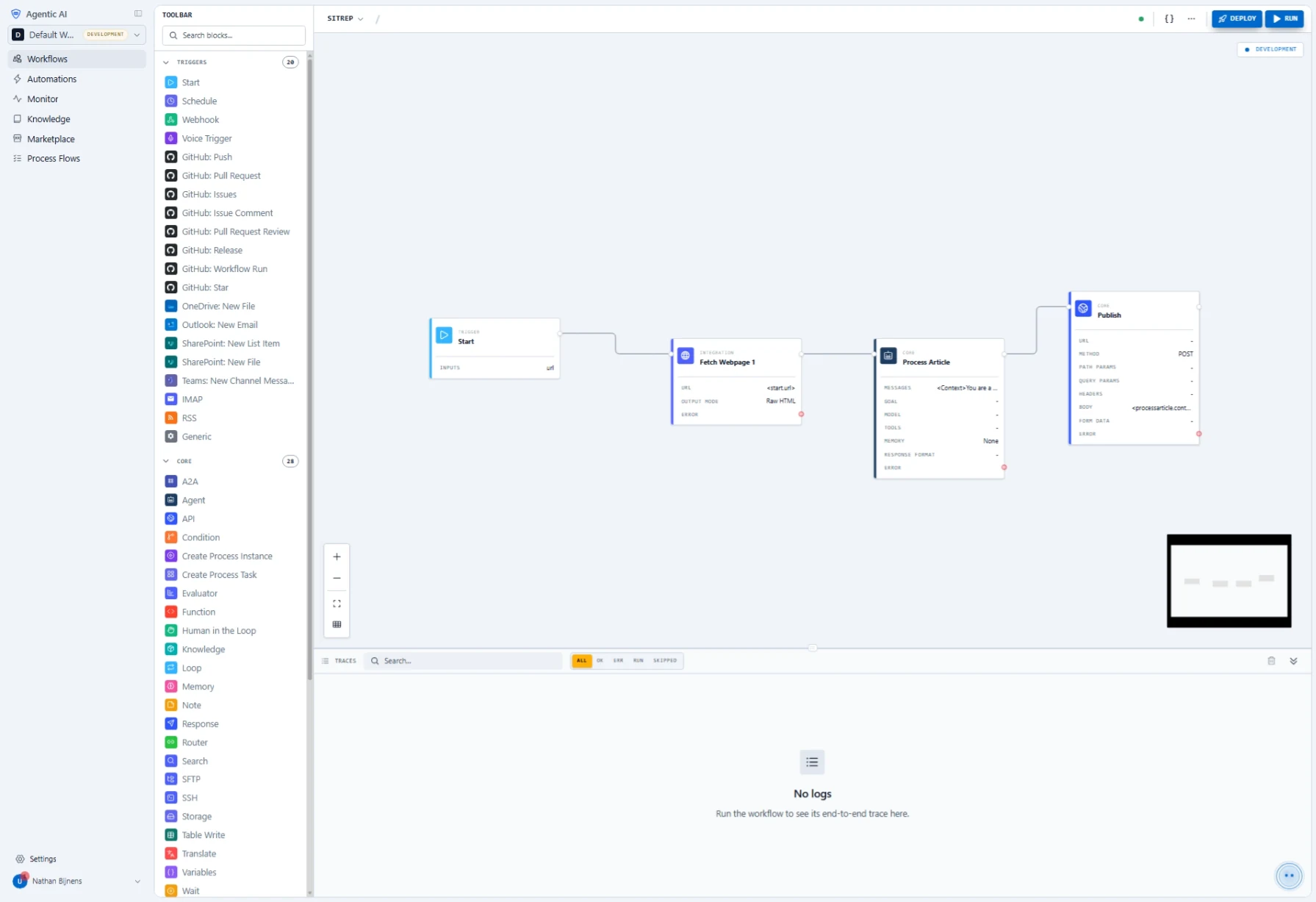
A workflow on the canvas: triggers and deterministic steps in the palette, an agent step where judgment is needed, human-in-the-loop and approval blocks in the same list — and the run itself below, block by block, with timings and the isolation it ran in.
Visual canvas — Drag, drop, and connect steps to compose an agent workflow — no orchestration code to write or maintain.
Native connectors — Wire in enterprise tools, data sources, and models as building blocks already available on the canvas.
Deterministic and agentic, combined — Mix fixed logic and approval steps with autonomous agent reasoning in the same flow.
Publish to the same runtime — A finished workflow deploys straight onto the AI OS runtime that runs every other agent on the platform.
Why business teams — not just engineers — need to build agents
The gap between an agent idea and a working agent is usually engineering bandwidth, not process complexity. The analyst who reconciles exceptions every week, or the operations lead who routes approvals by hand, already knows the workflow in more detail than any spec could capture — they just haven't had a way to build it. Putting the builder in their hands turns that backlog of small, high-value automations into things that actually get shipped, while freeing engineering time for the connectors, integrations, and complex multi-agent systems that genuinely need it.
Process knowledge lives with the business — The analyst running a process daily can encode it faster and more accurately than a developer working from a spec.
Minutes, not sprints — A workflow can be adjusted on the canvas the moment a process changes, instead of waiting on a release cycle.
Engineering time goes further — Platform teams focus on building governed connectors and complex agents, not hand-coding every routine automation.
Coverage beyond the backlog — Automations that would never make it onto an engineering roadmap still get built, reviewed, and shipped.
No-code that doesn't bypass governance
Making agents easy to build cannot mean making them easy to abuse. Every workflow assembled on the canvas runs under its builder's own identity and permissions, so it can only ever touch what that person is already authorised to touch — a business user can't drag together an agent that reaches further than they can. Sensitive steps still route through the same approval gates, every action still lands in the same audit trail, and every read or write still passes through the governed ontology rather than a shortcut API call. The no-code layer changes who builds the workflow, not what it's allowed to do.
Scoped identity — Every no-code agent runs under its builder's identity and permissions — it can never act beyond what its creator is authorised to do.
Approvals still apply — Sensitive steps require the same human sign-off on a no-code workflow as they would on a hand-coded one.
Full audit trail — Every step a business user drags onto the canvas logs its decisions and actions, reviewable by compliance like any other agent.
Ontology-grounded — Workflows read and write through the governed ontology rather than ad hoc API calls, so no-code automation can't quietly route around access control.
Frequently asked questions
What are no-code AI agents?+
How is this different from consumer no-code automation tools like Zapier or n8n?+
Who is the no-code AI agent builder for?+
Do no-code agent workflows bypass IT or security governance?+
Can no-code workflows include agents or tools built by engineers?+
Is the no-code AI agent builder sovereign and can it run on-premises?+
Explore the platform
Prefer to write? Email hello [at] scrydon.com and we will get back to you.
Partners